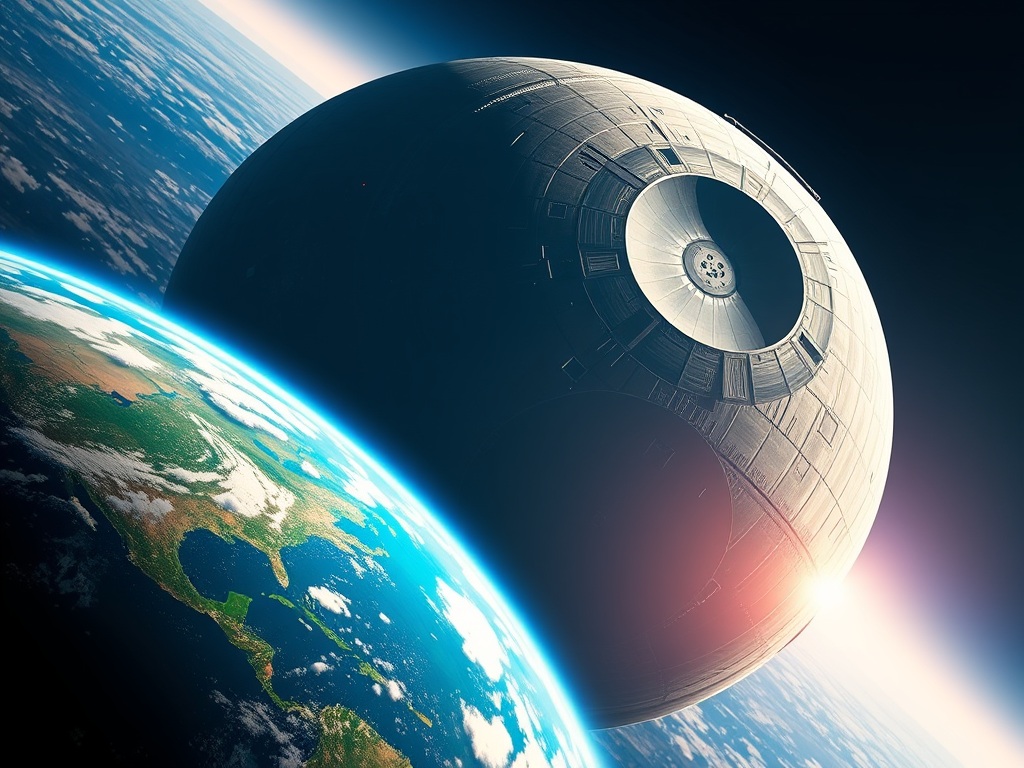
Life on the Death Star
Our presence in this vast universe is stunning. We inhabit a planet brimming with plant, animal, and human activity, while the remainder of the universe is orbiting rocks; we are an oasis of life in a massive desert of galactic desolation. Life appears to be an unwelcome intruder in a universe that wants to rest in peace. The inhabitants of our planet defy the interstellar norm by engaging in subversive acts of growth and reproduction. We thumb our noses at entropy as we procreate and populate our world with complex biological machines. For the average person, this rebellion lasts roughly 80 years until the counter-insurgency of death puts it down.
Our unique status in the cosmos raises an intriguing question: Why do we continue to protest against what is the cosmic norm? Why do we cling to the life force when the Death Star looms on the horizon? Not only do we tenaciously hold on to our brief existence, but we somehow believe it should be meaningful. We are either incredibly foolish or incredibly blessed.
Our brief encounter with life leaves us craving more. We cling to life even when all the evidence suggests it is the most absurd thing in the universe. We live for a relatively brief number of years and then get the crazy idea, contrary to all available data, that we should be immortal. Why, in a dead universe, does life emerge? It’s as if Someone set up a theater of the absurd in the middle of chaos, raised the firmamental curtains, cluttered the stage with animal props, and then introduced characters obsessed with their roles and the number of lines they recite. Perhaps the repetition in nature isn’t merely reoccurrence, but rather theatrical encore.*
Atheism finds itself in a challenging position because it must define humanity as a collection of extraordinarily fortunate genetic accidents whose only purpose is to keep their genes one lap ahead of the Grim Reaper in the natural selection marathon. It has only one option regarding origins: materialism, the belief that everything we experience is merely composed of physical substances. Why would a bunch of chemicals come together for an 80-year interlude, obsessed with purpose, only to become cosmic compost?
I have yet to find a best-selling book on purpose that outlines strategies to be a better survivor and have more offspring. Interestingly, atheists don’t read their self-help literature because statistics reveal that they have lower birth rates than the competing religious faction, which sadly prevents them from achieving the only purpose their worldview is capable of generating. Atheists then distract us from this sad reality by trying to create a temporal, material meaning to life, but find that the vast majority of people want one that is eternal and spiritual. Purpose and meaning either come from the natural world or the spiritual world. You cannot serve both god and evolution.
* Paraphrase of G.K. Chesterton.

 God's Screenplay