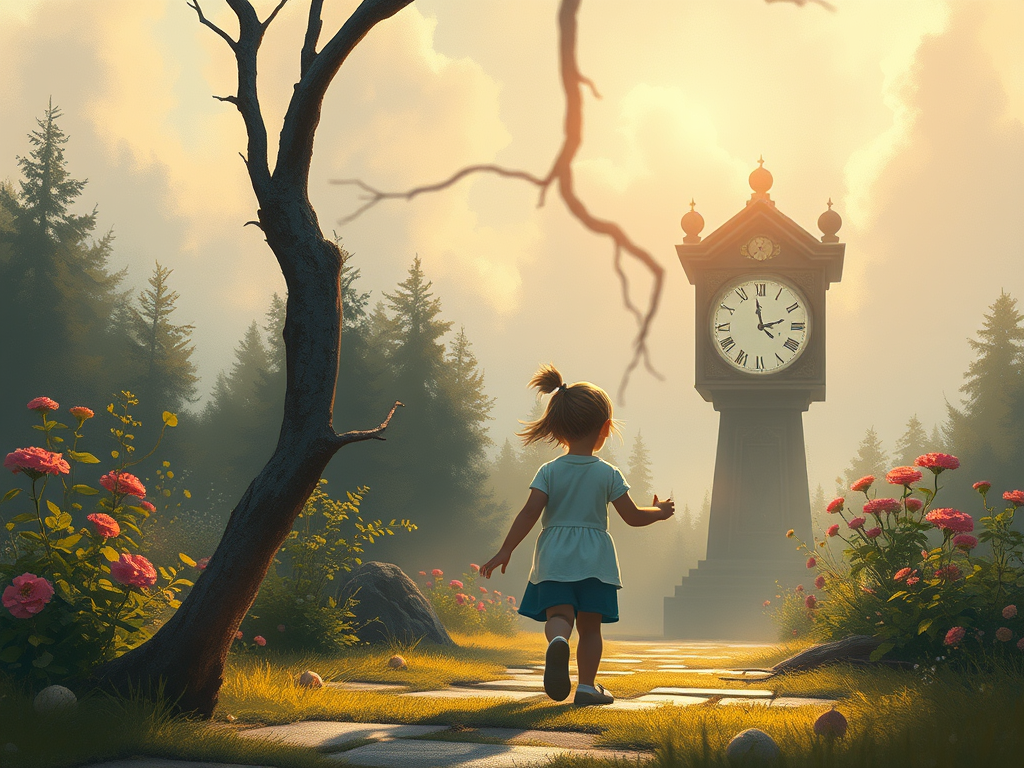
Time’s Up
So you run and you run to catch up with the sun but it’s sinking.
Racing around to come up behind you again.
The sun is the same in a relative way, but you’re older.
Shorter of breath and one day closer to death. (Time – Pink Floyd)
I recall, as a child, feeling like school would never end, and yet now, as an adult, I feel like there isn’t enough time to learn everything I want. I reminisce about the good old days, but squirm as I contemplate the future. Time can be a curse when it passes too slowly and a curse when it passes too quickly, but either way, we are under its spell. Sadly, the technology that we thought would free up our time is constantly looking over our shoulder, making sure that we are on task. The resulting problem isn’t the passing minutes but rather the lost moments.
“The ancient Greeks had two words for time, chronos and kairos. Chronos refers to chronological or sequential time. Chronos time is measured by the clock and calendar. It is orderly, rhythmic, and predictable. It is what we moderns typically think of as time. Kairos time, on the other hand, has a more nebulous meaning. It does not have an equivalent word in English. The least descriptive translation would be ‘in between time’—a moment of undetermined period of time in which ‘something’ special happens.” (1)
We can’t beat the clock, but we can make every second count. We may be physical slaves to the drumbeat of chronos, but we can be emotionally emancipated by kairos. We can measure our allotted time in minutes or meaning. The choice is ours.
One of my favorite authors, Frederick Buechner, differentiates between a child’s and an adult’s perception of time:
“… for a child all time is by and large now time and apparently endless. What child, while summer is happening, bothers to think much that summer will end? What child, when snow is on the ground, stops to remember that not long ago the ground was snowless? It is by its content rather than its duration that a child knows time, by its quality rather than its quantity.” (Frederick Buechner)
He suggests that it was when humankind fell that time became tyrannical.
Childhood’s time is Adam and Eve’s time before they left the garden for good, and from that time on, divided everything into before and after. It is the time before God told them that the day would come when they would surely die with the result that from that point on they made clocks and calendars for counting their time out like money and never again lived through a day of their lives without being haunted somewhere in the depths of them by the knowledge that each day brought them closer to the end of their lives. ” (Frederick Buechner)
While the clock may tick in the wilderness, God wants us to remember how it stood still in the Garden. He wants us to remember that our daily walks with Him weren’t just opportunities to get our steps in but were casual strolls in eternity.
Interestingly, in the New Heaven and Earth, there will be no sun to relentlessly mark our days and nights. Instead, it will be replaced by the presence of an eternal God who doesn’t need to consult a calendar.
And the city has no need of sun or moon to shine on it, for the glory of God gives it light, and its lamp is the Lamb. By its light will the nations walk, and the kings of the earth will bring their glory into it, and its gates will never be shut by day—and there will be no night there. (Revelation 21:23-25)
We can certainly hold onto the future hope that time will stop and eternity begin, but what will we do in the meantime?
God has made it possible for us to temporarily experience freedom from time by placing eternity in our hearts, where chronos is swallowed up by kairos.
He has made everything beautiful in its time. Also, he has put eternity into man’s heart, yet so that he cannot find out what God has done from the beginning to the end. (Ecclesiastes 3:11)
When God created the universe, He did it in an orderly, chronological manner… And there was evening and there was morning, the … day. He created chronos to be a rare timepiece, not a metronome of monotony. God created the sun, moon, and stars to memorialize time, not to run us ragged. After six days of chronological work, God rested in kairos. He sat in a timeless state, contemplating every moment of creation. The seventh day hasn’t ended, and God invites us to share in His rest. He wants us to get off the hamster wheel of events and live in the moment. Time waits for no man, but gauging eternity gives us all a chance to catch up.
Augustine said, “Thou hast made us for thyself, O Lord, and our heart is restless until it finds rest in thee.” God wants us to stop checking our watch, restlessly counting every second, and instead step into eternity with nothing but time on our hands.
With the incarnation, God did the religiously unthinkable and emptied Himself of eternity and stepped into time. He showed us the power of moments by coming to those who a cruel Roman culture wouldn’t give the time of day to. He was on the clock as His ministry was only three short years, yet He still took time to consider the lilies. Even though Jesus told His followers that His time was almost up, He knew that only through His death would eternal life be possible.
We may be getting shorter of breath and one step closer to death, but instead of concentrating on our panting, God calls us to sit quietly, take a cleansing breath of the Holy Spirit, and once again feel what it is like to be caught up in a God-breathed moment.
The meaning of existence is in the sanctification of time, in lending eternity to the moments. Being human is a quest for the lasting. (Abraham Joshua Heschel)
(1) https://www.kairosmomentum.com/2011/03/kairos-and-chronos-defined.html

 God's Screenplay