God of Patterns
Thoughts on the Uncommon Ground Debate
between
Joe Folley and Jonathan Pageau
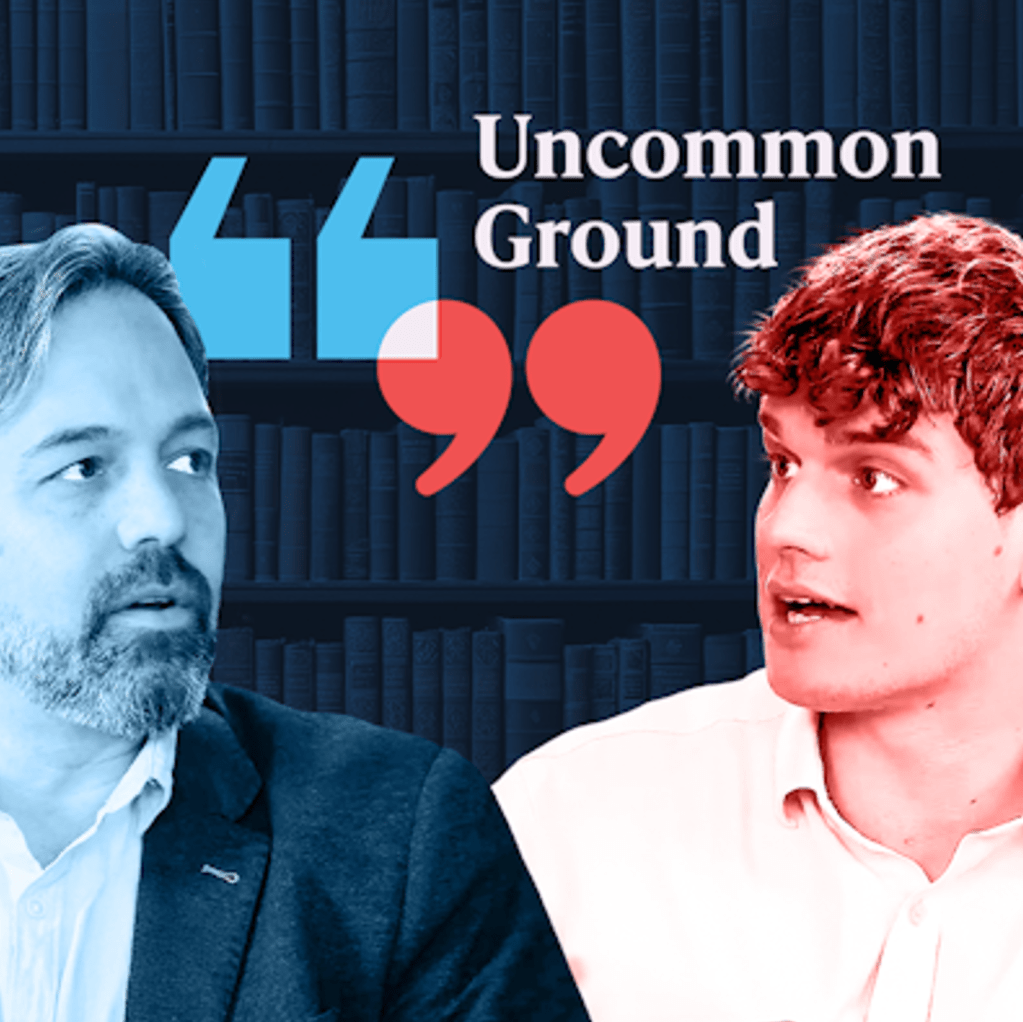
Justin Brierley once again delivered an engaging Uncommon Ground show by pairing atheist philosopher and podcaster Joe Folley with Christian commentator and icon carver Jonathan Pageau to discuss the existence of God. It was a compelling conversation that, for some, might have spent too much time in the weeds, but serious mental gardening is often necessary if one wants to discover the truth.
Truth
Truth is typically defined as the correspondence between thought and reality—the ability of an immaterial thought or idea to explain the physical world. Contrary to postmodern thought, truth isn’t created but discovered, which is why science is such a valuable tool for exploring it. The scientific method begins by observing patterns in the physical world, forming immaterial hypotheses about the nature and function of those patterns, testing them in the physical world, and then analyzing the data in the immaterial realm of mathematics to determine whether the results are statistically significant. Although science is often viewed as a materialist pursuit, it actually involves an ongoing dialogue between thought and reality, between the immaterial and the material. Even atheist scientists must dabble in the dark arts of immateriality by developing hypotheses and then hoping that, after testing, they get an abstract nod of approval. This raises a very interesting question: why does immateriality get the last word on reality?
Scientists often focus so much on studying biological Legos that they overlook the instructions in the box and the picture of the final product on the cover. Folley is willing to admit that there are some basic rules of Lego building that Legos instinctively know. Pageau, however, believes that without the instructions and cover, a formal and final cause, or an organizing Logos, the world is nothing but a pile of colorful bricks. Folley believes they all originated from the same warm little pond, while Pageau thinks they began as distinct streams of thought.
Immaterial oversight
Atheists recognize that there are immaterial aspects of life but are unwilling to grant them ontological status. To explain them without having to turn in their materialist membership card, they must appeal to the ill-defined concept of emergence, which suggests that if you get enough complex matter together, immateriality will appear. For instance, if you accumulate enough neurons and neurotransmitters, then consciousness will appear. As Pageau rightly pointed out, emergence is just a scientific word for magic. It doesn’t explain immateriality; it just ensures that it never forgets its material roots.
We all seem to acknowledge that an immaterial force guides the physical world. We thank it for a beautiful sunrise but also turn to it for help when our emotional skies are overcast. Who made immateriality the boss? Pageau argues that emergence cannot explain this authority because it would be strange if the immateriality that came from matter were able to exert top-down control over that from which it just emerged. Why would matter acquiesce to a higher power?
The renowned mathematician Eugene Wigner raised this very question in his paper, “The Unreasonable Effectiveness of Mathematics in the Natural Sciences.” Wigner’s paper could just as easily be titled, “The Unreasonable Effectiveness of Abstraction in the Real World.” Interestingly, the world has a hierarchy, and immateriality sits proudly on top.
Pageau described the hierarchy of life as a series of levels, each governed by a higher one, until reaching the top. Interestingly, psychologist Abraham Maslow’s well-known theory of the Hierarchy of Needs begins with physical needs like food and water but ultimately culminates in the immateriality of self-actualization – a process by which we gradually move through layers of decreasing materiality until we reach our immaterial goal. Sacred sites such as the Acropolis, the Oracle of Delphi, and the Temple in Jerusalem similarly required an ascent, suggesting that an upward journey is necessary to achieve spiritual wholeness.
I encourage my apologetics students when studying a particular topic to keep asking why, because with each successive why, they move up one more rung in the hierarchy until they finally reach the peak and encounter the ineffable. I think if Folley asked himself several more “why” questions, he might just be knock, knock, knocking on heaven’s door.
Folley’s problem is that his epistemological elevator doesn’t reach the top. He is stuck on a middle floor of patterns and analogies, contemplating what might be above but afraid to press the up button. The Good News for Folley is that God respects His fear of heights and took the time to take the elevator down. All He asks is that Joe meet Him when the door opens.
Patterns
Folley and Pageau agree that when we observe the world around us, we see patterns, but they disagree on the origin of those patterns. Merriam-Webster defines a pattern as “a discernible coherent system based on the intended interrelationship of component parts.” The question is not about the patterns themselves but about who or what “intended the interrelationship.” Pageau believes they are imposed on the world from above, while Folley argues that they emerge from below.
Folley suggested that part of their disagreement involved the role of the perceiver and the perceived in pattern detection. Folley pointed to the perceiver’s categorizing abilities, while Pageau believed the patterns were already embedded in the perceived. In Folley’s view, “man is the measure of all things,” whereas for Pageau, the measuring stick is in the hands of Someone greater.
“Where were you when I laid the foundation of the earth?
Tell me, if you have understanding.
Who determined its measurements—surely you know!
Or who stretched the line upon it? (Job 38:4-5)
God speak
Patterning communicates something about the world, but why would the world feel the need to tell us something, and why are humans the only ones listening? Animals don’t ponder patterns but instinctively live within them. Humans, on the other hand, can step outside the circle of life and not only watch it spin but notice when it wobbles.
Genesis offers us valuable insight because it depicts a mindful, organizing God who speaks “good” things into existence and arranges them into grammatically “very good” patterns. Folley is fascinated by this unity of multiplicity, which he describes as “a plurality united by a common syntax.” However, he cannot believe that this linguistic lyricism is the work of a greater Grammarian. Pageau, on the other hand, hears the rhythmic cadence of the words God spoke into creation and is drawn to the eloquence of the Speaker.
Materialists, by denying God, claim that patterns are universal brute facts. The problem with brute facts, however, is that they bully us into not asking from whence they came. Pageau, however, doesn’t want to be bullied but wants to trace their lineage back to the beginning. Philosophers, like Aristotle, tried to do this by proposing an unmoved mover, but Pageau dug deeper and discovered He has a name.
Wisdom
The conversation later shifted to wisdom. Wisdom is the knowledge we gain from continuously testing our thoughts against reality, enabling us to navigate life successfully. Simply defined, it is truth plus navigability.
Folley acknowledged that the Bible contains some wisdom, but he pointed out that wisdom can also be found in other religious texts. He makes a fair point, but what makes scriptural wisdom unique is that it is more than just maxims; it also explains the mechanism.
In the 9th chapter of the Book of Proverbs, wisdom is personified as a woman who is at God’s side, a master workman assisting Him in the creation of the world. The passage is lengthy, but I believe it offers deep insight into why wisdom is acquired through interaction with the world.
“The Lord possessed me at the beginning of his work,
the first of his acts of old.
Ages ago I was set up,
at the first, before the beginning of the earth…
When he established the heavens, I was there;
when he drew a circle on the face of the deep,
when he made firm the skies above,
when he establishedthe fountains of the deep,
when he assigned to the sea its limit,
so that the waters might not transgress his command,
when he marked out the foundations of the earth,
then I was beside him, like a master workman,
and I was daily hisdelight,
rejoicing before him always,rejoicing in his inhabited world
and delighting in the children of man. (Proverbs 8:22-23,27-31)
Wisdom, interestingly, delights not only in the inhabited world but also in the image-bearing creatures capable of recognizing her. Folley, while willing to admire her work, doesn’t seem willing to give her credit because she seems a bit too cozy with God.
Humility
Proverbs also tells us that “The fear of the Lord is the beginning of wisdom.” Fear in this context isn’t terror but awe. An awe beautifully described by the late Jewish theologian Abraham Joshua Heschel.
“The imperative of awe is its certificate of evidence, a universal certificate, which we all witness and seal with tremor and spasm, not because we desire to, but because we are stunned and cannot brave it. There is so much more meaning in reality than my soul can take in!” (Abraham Joshua Heschel)
Awe is humbly standing in the presence of something or Someone far greater than us.
In Plato’s “Apology,” Socrates’ childhood friend Chaerephon asks the Oracle at Delphi if anyone is wiser than Socrates. The Oracle replies that no one is wiser, which Socrates finds confusing because he knows many people who are more knowledgeable on various subjects than he is. As a result, he goes out and questions those he believes are more intelligent. He concludes after these conversations that the reason they are not wiser than him is that they are a bunch of know-it-alls. He says, “whereas when I do not know, neither do I think I know. So it seems I am wiser than he in this one small thing, that I do not think I know what I do not know.” It is a stance known in philosophical circles as epistemic humility.
I propose that epistemic humility, rather than simply accepting our ignorance, is recognizing that some thoughts are higher than our own.
For my thoughts are not your thoughts,
neither are your ways my ways, declares the Lord.
For as the heavens are higher than the earth,
so are my ways higher than your ways
and my thoughts than your thoughts. (Isaiah 55:8-9)
Interestingly, Socrates, a philosopher who knew nothing of the Bible, concluded that wisdom is bending an epistemic knee to unfathomable knowledge. Is the fear of the Lord any different?
Becoming
In a universe of unraveling, we experience becoming. Unraveling represents chaos and disorder, or in scientific terms, entropy. Becoming, on the other hand, is about directional patterning and organization. Stephen Hawking was puzzled by this as he searched for a unified theory of everything, prompting him to ask, “Why does the universe go to all the bother of existing?”
“Even if there is only one possible unified theory, it is just a set of rules and equations. What is it that breathes fire into the equations and makes a universe for them to describe? The usual approach of science of constructing a mathematical model cannot answer the questions of why there should be a universe for the model to describe. Why does the universe go to all the bother of existing?”
Hawking wanted to understand why the universe becomes. It’s a question we rarely ask ourselves because we just assume that is what matter does, which is unfortunate since it leaves deep questions unanswered, such as why nothing decided to become something, why non-life felt the need to live, and why non-consciousness felt the need to think about itself.
Telos
Stephen Iacoboni, in his excellent book, “Telos: The Scientific Basis for a Life of Purpose,” challenges our complacency about becoming.
“In light of all the endless examples of purpose-driven behavior on display in nature—every day in every place on earth—how can any objective science dismiss the overwhelming evidence of Telos in our vibrant, living world? Doesn’t the first task of all inquiry begin with observation?”
Iacoboni argued that Darwin’s theory of evolution eliminated purpose from the discussion, while ironically presuming its constant presence.
“It’s from Darwin’s theory that all the talk about purposelessness comes. Even as he assumed a purpose-driven biosphere of creatures in their struggle for survival, he ended up concluding that there was no purpose after all. The contradiction is as transparent as it is tragic.”
Where did this entropy-defying purpose originate? Can it emerge from a singularity or a warm little pond? Does purpose matter to matter, or is it an immaterial concern? Can you have purpose without a purposer?
Telos transforms life from a circle into a vector. Folley, however, seems stuck spinning on the hamster wheel of existence, while Pageau wants to show him that it is actually going somewhere. If life has no purpose, then why are humans so obsessed with it? In life, we are never content giving ourselves a pat on the back, but feel the need for Someone to say, “Well done, good and faithful servant.”
Analogical God
Folley says he is happy to believe in an “analogical god.” A mythical figure who lurks in patterns and analogies but never shows his face. A god we encounter when we conduct thought experiments, but who hides Himself when the rubber meets the road.
Pageau wanted Folley to see that patterns aren’t the end of an epistemic journey but are the starting point for a glorious intellectual ascent. He tried to free Folley from his left-brain bondage and invite him to take a seat on a right-hemispheric gondola and ascend the hierarchical heights. Folley, however, was reluctant; he feared that the intellectual air was too thin and he might hallucinate God.
I think part of the problem is that Folley tries to find God in His attributes. The Christian God, however, isn’t found in the omnis but in the emptying. While patterns and purpose may direct our thoughts toward Him, it is His incarnation that makes Him palpable. Perhaps Folley would reconsider his atheism if he set aside his search for epistemic certainty and embraced the ontological humility of the Word made flesh.
Turning Joe’s world upside down
Pageau noted that Folley’s world is turned upside down compared to his own. If that’s true, what would it take to flip Joe’s world?
Folley admitted that witnessing the resurrection in person would satisfy him, but he is cautious about learning about it through a sacred text. I suspect, however, that he accepts the historical consensus that Jesus was crucified. Christianity, while celebrating the empty tomb, is symbolized by a cross, so if Folley wants to take Jesus seriously, he might want to focus on the crucifixion rather than the resurrection.
St. Paul, a learned Pharisee, understood that lofty speech and wisdom paled in comparison to Jesus Christ and him crucified.
And I, when I came to you, brothers, did not come proclaiming to you the testimonyof God with lofty speech or wisdom.For I decided to know nothing among you except Jesus Christ and him crucified. (1 Corinthians 2:1-2)
Interestingly, Jesus said that when He was lifted on the cross, He would draw all people to Himself.
“And I, when I am lifted up from the earth, will draw all people to myself.” He said this to show by what kind of death he was going to die. (John 12:32-33)
Why would the death of a failed Messiah be God’s drawing card?
Pageau said, “The origin of all things, which is the God of love, binds all reality together.” Humans are always trying to organize large groups of people to create harmony, whether that be as cities, countries, or ethnicities, but they are incapable of uniting the whole. The only thing capable of uniting the world is love. St. John describes God as love, but how does the world tap into that trinitarian lovefest?
For God so loved the world, that he gave his only Son, that whoever believes in him should not perish but have eternal life. (John 3:16)
The God of love not only had to become human and show us how to love, but also to physically demonstrate the greatest love of all by laying down His life for the entire world. It is when Jesus is lifted up that love, the only true uniting force in the world, can bring us all together. Our salvation comes from the scars, not the skies; therefore, instead of dissecting proofs for God’s existence, Folley might want to see if his own physical and emotional wounds can find a loving home in the scarred hands and side of the Savior.

 God's Screenplay