Consciousness:
Thoughts on the Anil Seth and Iain McGilchrist Debate
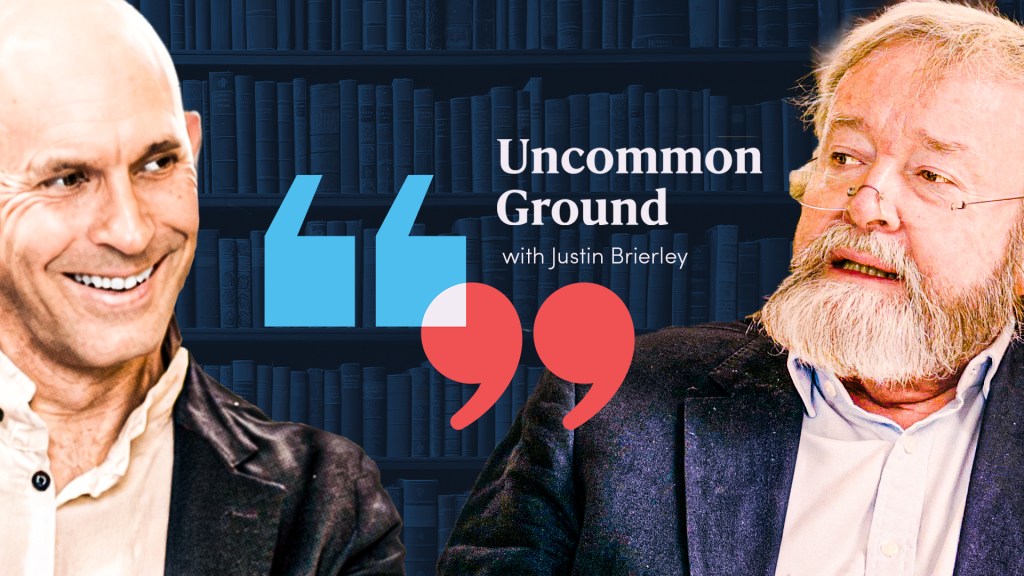
Consciousness, as philosopher David Chalmers concluded, is a hard problem. Materialists try to coax it out of matter, while religious thinkers try to squeeze it out of spirit. The challenge for both is less about the proposed origins and more about the point of contact. How do matter and immateriality cross the threshold and transform into one another? What kind of ontological trickery is needed? Anil Seth and Ian McGilchrist joined Justin Brierley’s new show, “Uncommon Ground,” to explore this question.
Cosmic Consciousness
McGilchrist finds it very difficult to define consciousness because he believes it is the cosmic air we breathe. Since we need consciousness to assess consciousness, he suggests we can never step outside of it to examine it objectively. He points out that because we directly experience consciousness and only indirectly experience matter, we should consider consciousness the primal source of everything. He believes that this consciousness pervades the universe, not pantheistically, in which everything is one consciousness, but panentheistically, in which consciousness is primary and all else is a manifestation of it.
McGilchrist likens this greater cosmic consciousness to water, which can exist as a solid, liquid, or gas. Consciousness is the H20 and matter is just one of its states or phases. He summarized this idea during a panel discussion at the Science of Consciousness Conference in 2021.
“I think that all that exists, exists in consciousness; that consciousness is the stuff of the cosmos. Matter is a phase of consciousness. It is not a separate thing, any more than ice is separate from water; it’s a phase of water; it’s neither less nor more than water; it’s not separate from water; it’s a kind of water. And matter is a kind of consciousness—for a time—that has certain quite marked properties that are different from the way we normally think of consciousness, just as water is transparent and flows and all the rest, and ice is hard and opaque and can split your head open. So, they’re different, but they’re part of the same ontology. Consciousness and matter must be distinguished—I argue strongly that they are distinguished, just as ice and water are—but there should be no need to set the one against the other.”(Iain McGilchrist)
Emergence
Seth, on the other hand, believes that matter is fundamental and that consciousness emerges from matter as it coalesces and becomes more complex. He acknowledges that “emergence” is a “tricky” word often “used as a placeholder for an explanation rather than as an explanation,” but to his credit, he wants to “puncture the balloon of mystery this word tends to inflate and develop practical, applicable, mathematical measures” to define it more clearly. He is hesitant to accept a “promissory materialism” that guarantees a material explanation for consciousness will eventually be found. Still, he doesn’t want to give up just because the problem is hard; rather, he wants to apply a serious Protestant work ethic to solving it.
Seth, like McGilchrist, uses the water analogy to make his point, arguing that gas, liquid, and solid—despite all being made of H2O—are perceived very differently. He explains that, just as the phases of water have unique characteristics, so does the brain. As the brain has evolved, with an increasing number of neurons and expanded connectivity, it has dramatically expanded the ways in which it expresses itself, resulting in consciousness. Seth appeals to the distinct external expressions of these properties to make his case, while McGilchrist focuses on the common substance from which they arise.
McGilchrist contends that the consciousness Seth likens to steam, liquid, or ice is ontologically distinct from matter, thereby rendering Seth’s analogy flawed. It is this “spooky” element of Seth’s emergent theory that concerns McGilchrist. While “and now for something completely different” may be appropriate for Monty Python, for McGilchrist, it doesn’t make for a very good scientific explanation.
Biological Brainchild
Seth describes consciousness as a “controlled hallucination,” in which our brains constantly generate and test non-physical hypotheses against reality, using ongoing sensory feedback to gauge their success. He calls them “hallucinations” because they lack physical form, but “controlled” because their purpose is to make navigating life easier.
“The reason brains are making best guesses, predicting things, in my view, is closely tied to the function of the brain in keeping the body alive. When you can predict, you can control, and I see this as an imperative that goes right down to the deeper layers of biology.”
While McGilchrist believes in a larger cosmic consciousness infused into the natural world, Seth believes that consciousness inevitably emerges as biological complexity increases. He suggests that the order that has evolved in biological systems, such as metabolism, homeostasis, and regeneration, when writ large, forms the biological foundation of consciousness.
“I think of consciousness as a biological property and biological properties as things that are generally the product of evolution.”
I’m intrigued by his idea that the human body’s anatomy, physiology, and biochemistry are so intricately organized, integrated, and finely tuned that it is inevitable the brain would exhibit similar properties. However, that still leaves open the question of whether an evolutionary mechanism of mutation and natural selection can produce something complex enough to hallucinate. Even Darwin had concerns about consciousness evolving from lower forms of life.
“But then with me the horrid doubt always arises whether the convictions of man’s mind, which has been developed from the mind of the lower animals, are of any value or at all trustworthy. Would any one trust in the convictions of a monkey’s mind, if there are any convictions in such a mind?”
In his excellent book “Evolution 2.0,” electrical engineer and business consultant Perry Marshall wondered why, if evolution is such a skilled builder, engineers don’t find its techniques useful in their designs.
“If blind evolutionary forces can produce eyes and hands and ears and millions of species, then why don’t engineers use Darwinian evolution to design cars or write software? Why don’t they teach Darwinism in engineering school? Evolution and natural selection, after all, were heralded as all-powerful, to the point of having godlike qualities. If nature needs no engineers, a little evolution knowledge would surely be useful to us engineers who are stuck in cubicles designing cell phones.”
If evolution can’t design “cell phones,” it’s also not capable of designing a human mind. It seems to me that if Seth wants to explain consciousness in terms of the body’s biology, he would be better served by considering a Creator who knit us together in our mother’s womb.
For you formed my inward parts;
you knitted me together in my mother’s womb.
I praise you, for I am fearfully and wonderfully made.
Wonderful are your works;
my soul knows it very well. (Proverbs 139:13-14, my emphasis)
In this short passage, Seth receives Biblical confirmation of his theory by linking consciousness (the soul) to an intricate biological infrastructure that is fearfully and wonderfully made.
Know thyself or Be Known?
Seth, while finding consciousness academically interesting, wonders whether debating it really matters in the larger scheme of things. Consciousness may help us navigate the world, but navel-gazing gets us nowhere. McGilchrist, however, believes that this preexisting consciousness, the ground of all being, is very important because it extended its consciousness to humans so they could “respond to, and take part in, the unpacking of… the primal origin of the universe.” For a secularist like Seth, all that is necessary is to biologically “know thyself,” but for McGilchrist, the imperative is to “be known.”
Man, or Myth?
Interestingly, while McGilchrist finds the Christian myth the most appealing, he doesn’t believe the myth needs to become fact.
“I don’t want to get involved in an argument about the historicity of Christ because I think these things are fruitless, and really, we don’t know. I don’t object to people saying that…it’s very important that he is a historical figure, and he was the son of God. I’m not saying that’s wrong, but all I’m saying is, for me, the important thing about that story is what it tells us. I don’t know any other mythos that has so many strands in it that are so beautiful.”
I find this fascinating because men with intellects comparable to McGilchrist’s, such as J.R.R. Tolkien and C.S. Lewis, believed that the Christian myth needed to put boots on the ground before they would join ranks.
“The heart of Christianity is a myth which is also a fact. The old myth of the Dying God, without ceasing to be myth, comes down from the heaven of legend and imagination to the earth of history. It happens—at a particular date, in a particular place, followed by definable historical consequences. We pass from a Balder or an Osiris, dying nobody knows when or where, to a historical Person crucified (it is all in order) under Pontius Pilate. By becoming fact it does not cease to be myth: that is the miracle.” (C.S. Lewis)
I suspect McGilchrist would find Thomas’ request to feel the nail holes in Jesus’ hands and side a bit too left-hemispheric, preferring the tales of a risen Jesus. Maybe he is concerned that if the Word became flesh, we risk bending a knee to the emissary rather than the Master. Maybe he is worried that if myth becomes fact, the spell will be broken.
I’m concerned that a Christianity that prizes a tall tale over a historical incarnation isn’t Christianity at all. Christians don’t meditate on myth; rather, they “behold the man.” The greatest story ever told isn’t a metaphor but a memoir. The relationship with the greater cosmic consciousness that McGilchrist proposes seems more like a Vulcan mind-meld than one sealed by no greater love. While St. Paul implores us to have the mind of Christ, without His scars, it is nothing but a long-distance relationship.
Return to Sender
McGilchrist’s conception of consciousness seems more like a thought experiment, while Seth’s approach resembles a vivisection. I believe that the Bible, beginning with Genesis 1, provides a clearer explanation than the theories of either of these esteemed thinkers.
God hovered over the chaos, contemplating the world He would create. Then, in a rhetorical flourish, He spoke “good” words in an ecologically “very good” way that could be understood by image-bearing beings equipped with divine voice recognition software. God shared His consciousness with the universe by speaking His mind, and we have all been invited into the conversation.
God’s words, like rain, water our hearts and produce a spiritual crop that we harvest and return to Him as the first fruits of praise. Praise that ensures His words never return to Him empty.
“For as the rain and the snow come down from heaven
and do not return there but water the earth,
making it bring forth and sprout,
giving seed to the sower and bread to the eater,
so shall my word be that goes out from my mouth;
it shall not return to me empty,
but it shall accomplish that which I purpose,
and shall succeed in the thing for which I sent it. (Isaiah 55:10-11)
God, however, wasn’t content to just talk the talk; He also walked the walk, revealing Himself not only in the words He spoke but also in the footprints He left in the sand. The mind-body problem was solved when the Word became flesh, offering those who labor to solve the hard problem of consciousness an opportunity to ease their academic burden and find rest for their souls.
Come to me, all who labor and are heavy laden, and I will give you rest.Take my yoke upon you, and learn from me, for I am gentle and lowly in heart, and you will find rest for your souls. For my yoke is easy, and my burden is light.” (Matthew 11:28-30)

 God's Screenplay