Abortion:
The Uncommon Ground Debate
Thoughts on the discussion between Ann Furedi and Lois McLatchie Miller
In an engaging episode of Uncommon Ground, pro-life advocate Lois McLatchie Miller spoke with Ann Furedi, the former head of BPAS, the UK’s main abortion provider, about the morality of abortion, focusing on when life begins, bodily rights, and human autonomy. The conversation was remarkable for its insight and the respectful, considerate way the guests interacted. As a neonatal physician intimately involved in the care of newborns, I would like to share some of my thoughts on this discussion.
Involvement
The abortion debate, with all its passion and controversy, isn’t for the faint of heart. Jumping into the fray can cost friendships and create enemies. It demands strong resolve and resilience, so your reasons for participating must be compelling. Furedi got involved because she was concerned that the issue had become overly politicized and had neglected the “lived experience of women” with unwanted pregnancies, “many of whom would not regard themselves as being pro-choice or anti-choice” but “who simply had this huge life-altering moment…they felt they needed to do something about.” She worried that general legal solutions and political sloganeering failed to address the complex and often tragic personal circumstances that lead women to make such a significant choice—decisions best made in consultation with family, friends, and physicians.
Miller, on the other hand, had been studying surrogacy for a human rights law degree and realized that if fetuses were being bought and sold, she needed to consider whether laws against child trafficking might also apply to the unborn. “If we are doing all this work to say that a child has the right not to be sold, then surely a child has a right to protection for their life.” The main difference between these two women was their focus: Furedi prioritized the mother’s situation over that of the fetus, whereas Miller felt that the rights of the preborn were being ignored.
My Motivation
My passion for this subject stem from 25 years of caring for critically ill infants, many of whom met the gestational age criteria for abortion. As a neonatologist, I have encountered many brave women who endured challenging pregnancies marked by multiple hospitalizations, prolonged bed rest, and various medical and surgical procedures to prevent miscarriage and premature delivery. I have treated infants born to parents who underwent multiple rounds of infertility treatment, desperately hoping to conceive. My connection with these women is rooted in a shared dedication to life, from the womb to the hospital room.
I found that my commitment to preserving life was at odds with an increasingly vocal group that treated pregnancy like a sexually transmitted disease in need of medical therapy. However, to incorporate abortion into the healing arts, whose motto, ironically, is “primum non nocere – first, do no harm,” they had to engage in a bit of postmodern prevarication and rebrand abortion as Reproductive Health Care. A label I find quite deceptive, given my experience with women who looked to the health care system to promote reproductivity. Once abortion becomes a cornerstone of women’s health care, babies become pathogens. Explain that to your children!
Black box
I believe the main reason people support abortion and not infanticide is that abortion is hidden in a black box, while infanticide would have to occur in the light of day. It is easier to see no evil, hear no evil, and speak no evil when you can’t witness what is being done. Abortion takes place in a dark space where no one can hear you scream. Sadly, out of sight becomes out of mind, and those who are unseen suffer in silence. There is, however, hope because with the advent of high-resolution ultrasound, we now have a window into the womb, and what was once described as a “blob of cells” now has its mother’s and father’s eyes, ears, hands, and feet.
In a culture increasingly suspicious of institutional authority and obsessed with choice and bodily autonomy, you would think that those who support abortion would be the fiercest advocates for informed consent. In America, however, it appears that the details of the procedure are withheld or downplayed because they are considered emotionally cruel. This practice seems a tacit admission of just how disturbing the procedure truly is.
Informed consent is one of the pillars of the proper practice of medicine; therefore, an ultrasound and a detailed explanation of the procedure should be mandatory before every abortion. Abortion isn’t taking out the trash; it is a surgical procedure that requires a thorough discussion of the risks and benefits. Medical abortions, while avoiding surgical intervention, are nonetheless just as problematic. Pharmacological interventions allow one to abort in the comfort of one’s own home, making it as easy as taking a pregnancy test, with one huge difference: instead of seeing a positive test strip in the bathroom after urinating, the woman encounters the one who made her test positive floating in the toilet. The surgical abortionist can hide the body parts from the woman, but with mail-order abortion pills, the mother will see them firsthand. Sadly, in this context, consent is truly informed only after the deed is done.
Sadly, abortion unravels what was fearfully and wonderfully knit together in the womb. My hope is that if the woman were able to see the remarkable fetal tapestry, she might have second thoughts about fraying it and perhaps even give thanks to the Embroiderer.
Welcoming Committee
The once-noble role of the obstetrician as the head of the human welcoming committee has been restructured to include stints as an immigration officer, restricting fetal entry into the land of the living. The once-irrevocable passport into the world of equal opportunity has been reissued as an organ donor card. Abortion replaces the delivery room ritual of comparing the baby’s fingers, eyes, and toes to those their parents with the cold, calculated, surgical cataloging of fetal body parts.
Author Annie Dillard describes how an obstetrical ward should be viewed:
“There might well be a rough angel guarding this ward, or a dragon or an upwelling current that dashes boats on rocks. There might well be an old stone cairn in the hall by the elevators, or a well, or a ruined shrine wall where people still hear bells. Should we not remove our shoes, drink potions, take baths? For this is surely the wildest deep-sea vent on earth. This is where people come out.” (Annie Dillard)
Has the wildest deep-sea vent on earth, where the people come out, become a loo where they are flushed away?
A fetus is either an oppressor seeking to take away the inalienable right to have sex, or a fountain of youth from which the next great generation of movers and shakers flows. Which is it, a reproductive disaster or a procreative miracle? You can’t have it both ways. The social conditions and desires of the woman may change her life situation, but they do not change the unborn’s status. A fetus is not a tumor requiring chemotherapy or an abscess requiring drainage; it is a unique human life that cries out for protection. When another life is at stake, we cannot base our decision on the right to choose but on the inalienable right of the one chosen.
Location, location, location
One of primary mantras of the real estate profession is “location, location, location,” which may matter when buying or selling a house but is irrelevant when gestating a human being. Miller believes that the baby’s location has no bearing on its worth. An eight-inch distance from the womb to the room doesn’t change the baby’s value and therefore should not factor into the decision to have an abortion. Furedi, on the other hand, believes location is crucial, not so much in terms of geography, whether inside or outside the womb, but in regard to the governing bodies. She considers the mother sovereign over the womb and, as such, has the divine right of a queen to decide who shall live and die. After birth, however, she must relinquish her power as the baby enters a new jurisdiction where it surprisingly acquires rights it was denied in the womb. The problem is that while citizenship may change, the value of the one migrating does not.
Don’t Mess with the Vector
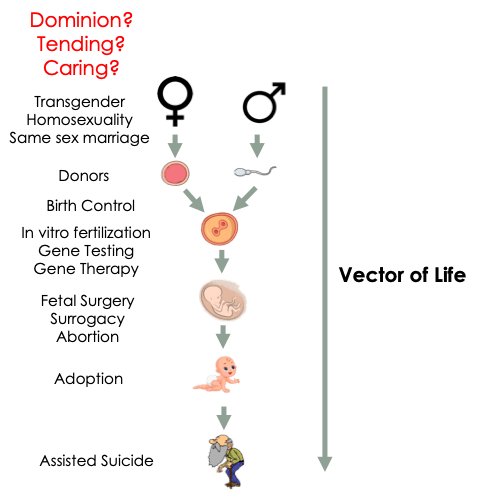
God, or nature if you like, has given us a Garden-variety sexuality that has kept the planet populated with humans for millennia. A man and a woman come together in a sexual union, the sperm fertilizes the egg, and a vector of life is initiated, which, left to its own devices, will result in a baby who will go on to become an adult. A vector has both magnitude and direction, so we need to be very careful when we mess with it because when we do, not only will it veer off course, but the consequences will be magnified along the way. We live in a fallen world, and nothing works ideally, so as image bearers, we may need to give the vector some assistance, but we must be careful to limit our interventions. Sadly, humans far too often treat slippery slopes as entertaining slip-and-slides rather than moments when we perilously teeter on the edge of disaster.
Choice
Pro-choice seems an odd way to characterize abortion, given that proper choice requires that options be clearly spelled out and potential consequences fully considered. Abortion, rather than an exercise of choice, is actually an escape clause for a poorly made one. Choice has become a postmodern mantra that values lifestyle over the public good. It accepts a little bit of drug use, a sexually acquired disease, or an unwanted pregnancy as a small price to pay to preserve our inviolable right to choose. We seem loath to call people out for their bad lifestyle choices and instead turn to the government to use our hard-earned tax dollars to clean up their mess. Sadly, society failed to read the warning label before it became hooked on the drug of choice, and now we are all suffering from its inevitable side effects.
Gold Standard
The most important choice is the first one, when the man and woman ask themselves whether they are prepared for the potential consequences of engaging in a sexual act. Sadly, nobody talks about this first choice. The abortion discussion usually proceeds as if the woman had mysteriously become pregnant, a virgin conception imposed upon her by some malevolent deity, forcing her to choose an abortion. Instead of debating the primary cause, we restrict ourselves to debating its fallout.
The last time I checked, abstinence was safe, organic, and 100% effective at preventing pregnancy. However, once a couple decides not to follow the science and engage in a procreative act, they risk facing progressively more serious physical consequences, beginning with the side effects of contraceptives, proceeding through the risks of abortion pills, and possibly ending with surgical complications. I realize people will say I am naïve and that boys will be boys and girls will be girls, but we aren’t animals in heat; we are human beings with the ability to choose.
Reproductive choice is not just a woman’s responsibility. If a man truly values the woman with whom he plans to be intimate, he needs to acknowledge the potential burden that decision could place on her if she were to become pregnant, whether it is the physical discomfort of pregnancy or, worse yet, the psychological trauma of a surgical termination.
Poison Pill
The introduction of birth control created a serious rift between sex and childbearing, transforming pregnancy from a celebrated baby bump into a mountain too difficult to climb. Women are told that instead of being pregnant with possibility, they will be weighed down by the gravity of gravidity. However, it is children who have been most severely affected by this separation. Babies have gone from being a blessing to an inconvenience to a disease.
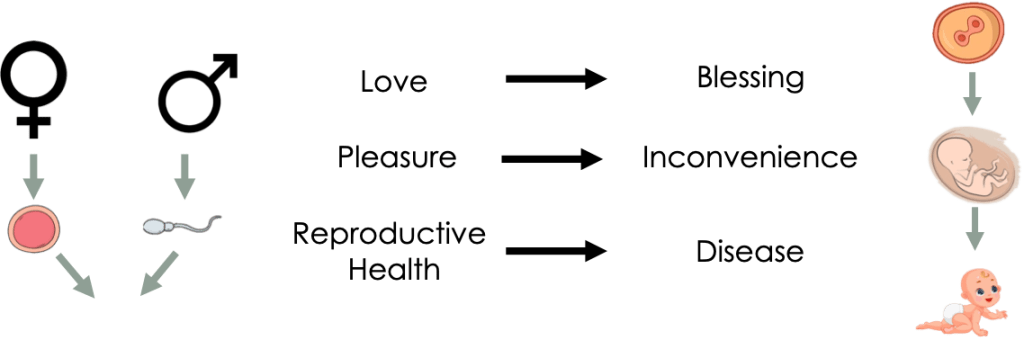
While birth control may have been a good thing for true family planning, like all other human interventions, we used it to become like God and ended up ruling as emperors with no clothes.
Autonomy
Furedi is concerned about the bodily autonomy of the woman being violated by an unwelcome fetus. However, I would ask her if the preservation of bodily autonomy should begin earlier in the process, such as when one consents to a sexual union. If bodily autonomy is the summum bonum, then it should be practiced as primary and not be used as an excuse to later bail one out of a difficult circumstance. It would be a far better exercise of bodily autonomy to pay attention to the first violation than the far more complicated later one. Critics will point to the bodily autonomy lost in rape and incest, but those cases represent a small number of actual abortions and require a different discussion.
Furedi does identify herself as pro-family, which is admirable. A family traditionally includes three equally valued members: a mother, father, and child. However, when an extra child is viewed as harmful or unwelcome to the family unit, it implies that children, rather than essential equal partners, are seen as optional decorative accessories.
Conclusion
I really enjoyed this discussion. Both Furedi and Miller were exceptionally articulate and thoughtful. Furedi is a rare pro-choice advocate who has thought deeply about this topic and continues to do so. I appreciated her concern for the tragic circumstances that women contemplating abortion face, which are often forgotten in these debates. But addressing a tragedy with a tragic solution seems to compound rather than solve the problem. In my career, I have met numerous families eagerly awaiting the chance to adopt a baby. I would say they are often the people most prepared to care for a newborn. I would therefore encourage any woman contemplating abortion to consider adoption, knowing that the precious life growing in her womb will be placed in good hands.


